A restaurant lead list should be more than a spreadsheet of names, phone numbers, and generic inboxes. If you sell software, supplies, equipment, marketing services, payments, staffing, logistics, or almost anything else to restaurants, the list has to answer three questions at once: which restaurants actually fit your market, who can make the buying decision, and how can you reach that person with data fresh enough to use.
That sounds simple until you try to build the list at national scale. Restaurants are fragmented, local, frequently independent, and unevenly represented in traditional B2B databases. A neighborhood bistro may have an excellent Google profile and active Instagram account but almost no LinkedIn footprint. A multi-location operator may use different websites or phone numbers by location. A franchise location may look like a perfect fit until you discover that the local operator cannot choose the vendor you sell.
The goal of this guide is to show a practical way to build the market from the ground up. It is the same basic thinking behind HashZinger's custom market builds: define the universe first, then enrich the businesses and people that matter.
Quick answer: start with the restaurant universe, not with email addresses. Define the exact restaurant types and geographies you want, map the locations, normalize and deduplicate them, identify ownership and decision makers, enrich contact details, verify deliverability, then add the qualification signals that make the list useful for your offer.
What a useful restaurant lead list actually contains
A strong restaurant list has three layers.
Business layer. This identifies the restaurant itself: name, full address, city, state, ZIP code, phone number, website, cuisine or category, rating, review count, and location count.
Ownership and decision-maker layer. This tells you who can actually buy: owner, founder, operator, general manager, director of operations, purchasing manager, or another role that matches your offer.
Qualification layer. This tells you whether the restaurant is worth contacting. Useful signals can include independent versus franchise, single location versus multi-location, cuisine, online ordering, reservation platform, website quality, recent opening, geographic radius, review volume, or any other criterion connected to your product.
The biggest mistake is treating every field as equally important. A catering supplier may care deeply about cuisine, event capacity, and location count. A POS vendor may care more about ownership structure, existing technology, and whether the restaurant can choose its own systems. A local marketing agency may care about review count, website quality, and recent activity.
The list should reflect the actual sales motion.
Why restaurant prospecting is harder than it looks
The United States restaurant market is large enough that a generic search quickly becomes noisy. The U.S. Census County Business Patterns data for 2023 records 258,626 full-service restaurant employer establishments and 270,088 limited-service restaurant employer establishments. That is more than half a million establishments across just those two categories, before accounting for snack and beverage businesses, mobile food services, bars, cafeterias, and adjacent food-service categories.
Scale is only one problem. Structure is the bigger one.
A restaurant location is not always the same thing as a restaurant company. One operator can own five concepts. One brand can have hundreds of franchised locations. A local chain may have a single corporate contact but separate managers at each venue. An independent restaurant may have no obvious company record at all.
That is why restaurant prospecting benefits from the same local-first research logic we use for fragmented local businesses. You have to decide what your unit of targeting actually is.
If your offer is sold per location, each venue may be a lead. If your offer is bought centrally, the operating company or ownership group may be the lead. If local managers influence the purchase but ownership approves it, you may need both levels in the same dataset.

How to Build a Restaurant Lead List Step by Step
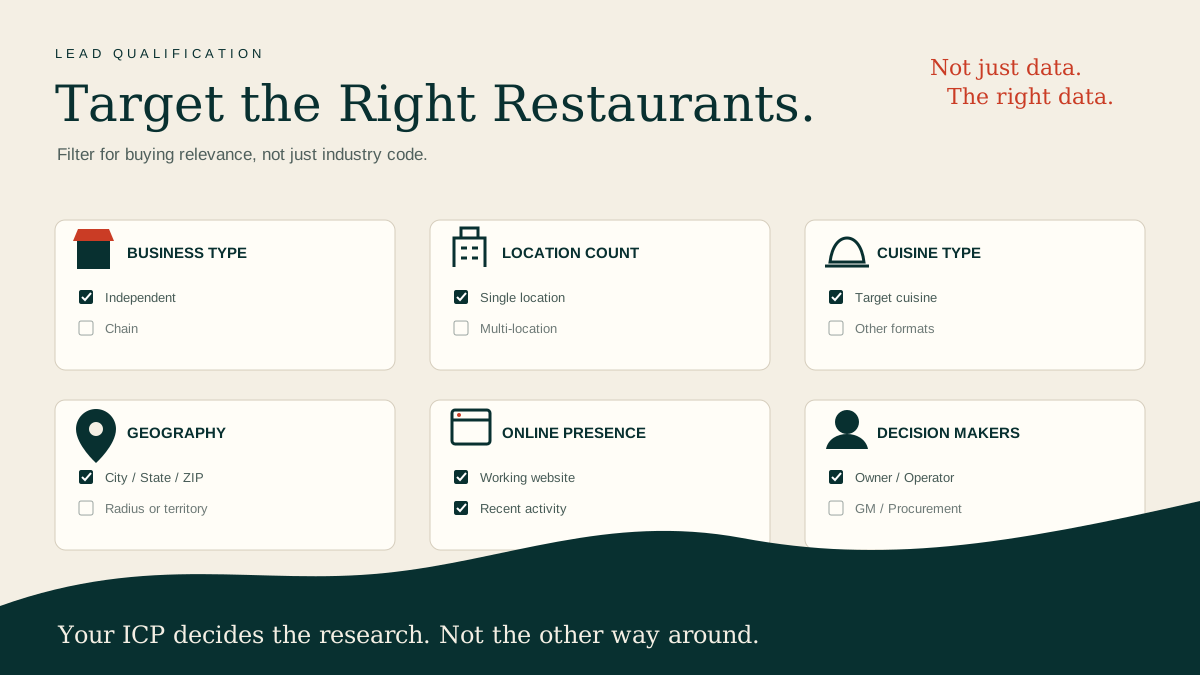
1. Define the restaurant ICP before collecting anything
Start by writing the inclusion and exclusion rules in plain language.
A useful brief might look like this:
- Independent full-service restaurants in Texas, Arizona, and Colorado
- One to five locations
- Exclude national chains and hotel restaurants
- Minimum 100 Google reviews
- Must have a working website
- Target owner, managing partner, or general manager
- Prefer restaurants with online ordering
- One to two verified contacts per company
That is far better than starting with "restaurants in the US."
Your filters do not need to be perfectly machine-readable at the beginning. They need to be commercially meaningful. If the thing you care about is unusual, such as "independent theaters with a certain purchasing profile" or "restaurants that look likely to buy premium imported ingredients," write the real requirement first. Source selection comes after the brief. That is also the logic behind our sourcing and enrichment process.
2. Decide whether you are targeting locations or companies
This decision prevents duplicate outreach and bad account counts later.
For a one-location restaurant, the distinction barely matters. For a five-location local group, it matters a lot.
Build at least two IDs in your data model:
- Location ID: one physical restaurant location.
- Company or operator ID: the business entity or ownership group behind one or more locations.
You can still export a simple CSV at the end. The point is to preserve the relationship while researching.
If a buyer controls multiple locations, that can become a powerful prioritization signal. Five venues under one owner may be much more valuable than five unrelated single-location restaurants.
3. Map the business universe
At this stage, do not obsess over email addresses yet. The job is to find the restaurants that exist and fit the broad market definition.
Useful discovery signals include:
- Business name
- Address and geographic coordinates
- Primary and secondary categories
- Phone number
- Website
- Rating and review count
- Opening hours
- Price level when available
- Social profiles
- Reservation or ordering links
For a national build, work geography by geography rather than relying on one huge query. States, cities, counties, ZIP codes, and metro areas give you better control over coverage and deduplication.
This is where many purchased lists become weak. They may contain an impressive number of rows, but you do not know whether the market was covered consistently or whether the same operator appears multiple times under slightly different names.
4. Normalize names, addresses, domains, and locations
Restaurant data is messy because names are messy.
"Joe's Pizza," "Joe's Pizza NYC," and "Joe's Pizza - West Village" may refer to the same brand, different locations, or completely different businesses. Domains can help, but a multi-location group may use location pages on one site. Phone numbers and addresses become additional matching signals.
Normalize:
- Business names
- Street abbreviations
- Phone formats
- Domains
- State names
- ZIP codes
- Location URLs
Then deduplicate at both the location level and the company level.
A good rule is to keep the raw source fields alongside the normalized fields. If something looks wrong later, you can trace where the value came from.
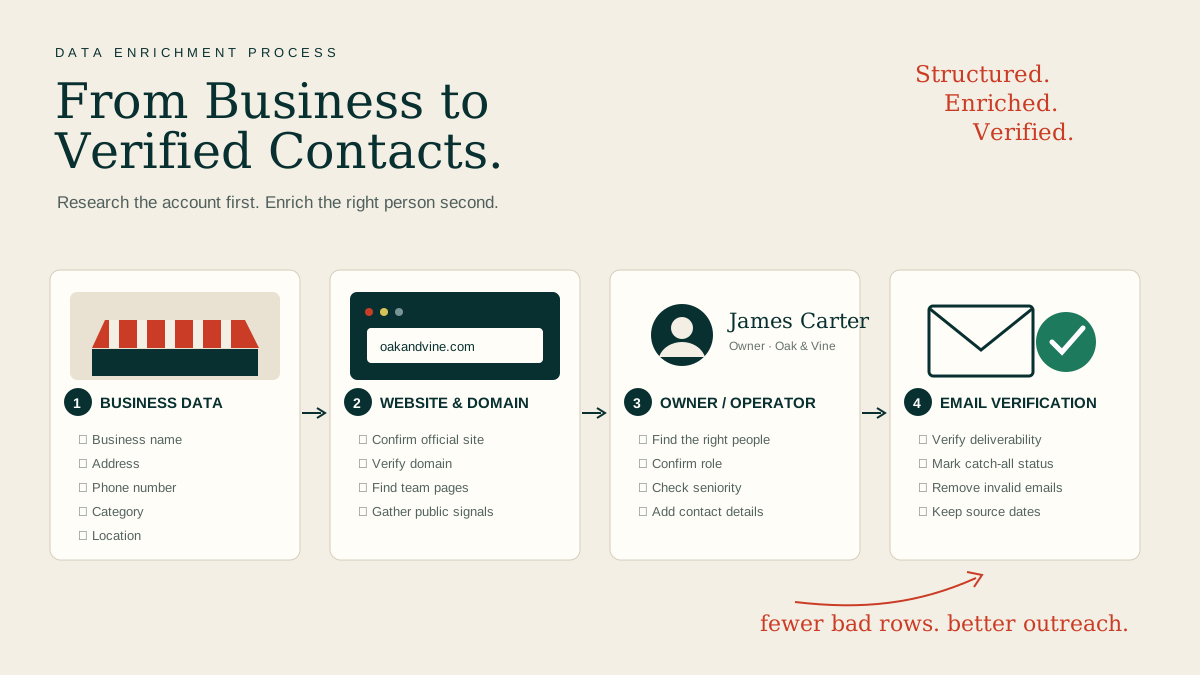
5. Confirm the official website and operating identity
The official restaurant website is often the bridge between a local listing and the people behind the business.
Use it to confirm:
- Whether the restaurant is still operating
- The exact brand spelling
- Additional locations
- Ownership or team pages
- Catering or private dining activity
- Contact pages
- Ordering and reservation tools
- Press pages
- Franchise information
A website also helps distinguish a true independent from a location that only appears independent in a directory.
6. Identify the right restaurant decision makers
The "best" title depends on what you sell.
For many independent restaurants, the owner or founder is ideal. For larger venues, a general manager may control local vendors. For multi-location groups, operations, procurement, finance, marketing, or technology roles can be more relevant.
A practical hierarchy is:
- Owner, founder, or managing partner
- Operator or director of operations
- General manager
- Purchasing or procurement contact
- Functional buyer related to your offer
Do not automatically collect five people at every restaurant. More contacts can create more noise, duplicate outreach, and unnecessary enrichment cost.
For small independents, one strong contact is often enough. For larger restaurant groups, two or three contacts can make sense because buying authority is distributed.
7. Enrich contact data only after the account fits
This ordering matters.
If you enrich every restaurant first and filter later, you pay to find contacts for accounts you never wanted. Instead, qualify the business as far as possible using company-level signals, then enrich people for the remaining accounts.
Useful contact fields include:
- First name
- Last name
- Job title
- Email verification status
- Phone or direct dial when relevant
- LinkedIn profile when available
- Source or confidence field
Restaurant owners are often harder to find than employees at larger B2B companies because they may have limited professional profiles. That is normal. Use multiple signals instead of assuming one database should contain everyone.
8. Verify emails before outreach
An email address that looks correct is not the same as an email address that is safe to send.
At minimum, separate:
- Valid or accepted
- Catch-all
- Invalid
- Unknown
Keep verification status as its own field. Do not overwrite the original email with a blank value just because verification is uncertain.
If you are choosing between multiple contacts at the same restaurant, a verified email for the second-best title may be more useful than an unverified email for the perfect title.
9. Add qualification signals that match your offer
This is where a restaurant list stops being a directory and becomes a sales dataset.
For example, a payment company could add location count, ordering methods, website checkout, and delivery platforms. A premium food supplier could add cuisine, menu signals, price point, number of locations, and whether the restaurant emphasizes specialty ingredients. A marketing agency could score website quality, review volume, social activity, and whether online reservations are enabled.
Which restaurant lead list fields matter most?
A useful schema does not need 80 columns. It needs the fields that help you segment, personalize, route, and verify.
| Field group | Useful fields | Why it matters |
|---|---|---|
| Identity | Restaurant name, normalized name, domain | Deduplication and account matching |
| Location | Address, city, state, ZIP, coordinates | Territory and local targeting |
| Classification | Cuisine, restaurant type, independent or chain | ICP filtering |
| Scale | Location count, operator group | Account value and routing |
| Public presence | Website, phone, rating, review count | Freshness and qualification |
| People | Name, title, role seniority | Decision-maker targeting |
| Contact | Email, phone, verification status | Outreach readiness |
| Custom signals | Tech, menu, ordering, hiring, recent opening | Relevance to the offer |
If a field will not affect targeting, messaging, prioritization, or routing, ask why you are collecting it.
Restaurant segmentation examples
The same restaurant market can produce very different lead lists.
Restaurant software
Prioritize location count, ownership type, existing technology, online ordering, reservation system, and operational roles. A single franchise unit may be a poor target if technology is mandated by the brand.
Food and beverage suppliers
Cuisine, menu style, price point, independent ownership, geography, and number of locations can matter more than employee count. You may also want chefs, owners, purchasing contacts, or operations leaders.
Agencies and local service providers
Website quality, review volume, recent activity, social presence, and location radius may be more useful than corporate firmographics. This is one reason client and campaign proof matters when evaluating a provider that claims to understand local markets.
Equipment and facility vendors
Restaurant type, seating format, location age, recent opening, expansion signals, and multi-unit ownership can help prioritize accounts where the timing is stronger.
The market is the same. The useful dataset is not.
How many leads should you collect per restaurant?
For most restaurant outreach, quality beats contact volume.
A sensible default is:
- Independent single-location restaurant: 1 strong contact
- Small multi-location group: 1 to 2 contacts
- Larger regional operator: 2 to 3 contacts
- Complex account: add contacts only when they represent different buying functions
If you need 10,000 restaurant companies, collecting three weak contacts per company does not magically create 30,000 good leads. It can simply triple your enrichment cost and increase the chance that multiple people at one business receive the same campaign.
Start with the minimum number of people required to reach the buying center.
Freshness, validation, and compliance
Restaurant data decays quickly because businesses open, close, relocate, rebrand, change operators, and update websites. Freshness should be treated as a field, not as a vague promise.
Record when the business was last checked and when the email was last verified. If the list sits unused for months, consider rechecking contact data before launching outreach.
If you use the list for commercial email in the United States, your campaign also needs to follow applicable rules. The FTC's CAN-SPAM compliance guide covers requirements including accurate header information, non-deceptive subject lines, a valid postal address, and a functioning opt-out mechanism.
Data quality and outreach compliance are separate jobs. A verified email does not make a campaign compliant by itself.
Common restaurant lead generation mistakes
Starting from email instead of market coverage
This creates a list biased toward restaurants that are easy to find online rather than restaurants that actually fit the ICP.
Treating every location as a different company
You lose the ownership relationship and may contact the same operator repeatedly.
Ignoring franchise structure
The location may have no authority to buy what you sell.
Using generic inboxes as the default
A public info@ or contact form can be useful, but it should not replace a decision-maker contact when your offer requires owner or operator approval.
Skipping verification
One of the fastest ways to damage an outbound campaign is to mix stale business data with guessed emails.
Collecting too many irrelevant fields
A massive schema can make the dataset look sophisticated while slowing delivery and adding no commercial value.
Buying a static list without knowing the methodology
Ask how the market was sourced, when the records were checked, how duplicates were handled, and what "verified" actually means.
Should you buy a restaurant list or build one?
There is no universal answer.
A prebuilt list can be fine when your ICP is broad, your required fields are basic, and the provider can demonstrate freshness. A custom build is usually stronger when your target depends on local coverage, ownership structure, custom signals, unusual exclusions, or decision-makers that standard databases miss.
The real question is not "buy or build?" It is whether the dataset represents the market you actually want.
HashZinger's approach is to start with the brief and build around it. You can see some of the third-party references and receipts on our mentions page, but the more important test is whether the sourcing method makes sense for your exact market.
A practical restaurant lead list workflow
Before exporting the final CSV, run this checklist:
- Define the restaurant types, geography, ownership rules, and exclusions.
- Decide whether your account unit is a location, company, or operator group.
- Build the broad restaurant universe.
- Normalize names, addresses, domains, and phone numbers.
- Deduplicate at both location and company level.
- Confirm the official website and current operating status.
- Apply company-level qualification signals.
- Identify the right decision-maker roles.
- Enrich one to three contacts based on account complexity.
- Verify email status and preserve the result as a field.
- Add source dates and quality-control flags.
- Manually review a sample before sending the full dataset into outreach.
That final sample review matters. Inspect 50 to 100 rows like a salesperson would. Are these businesses genuinely in the ICP? Are the titles sensible? Do the websites match? Are franchises being handled correctly? Are location groups obvious?
A small manual QA pass can catch systemic mistakes before they become 10,000-row mistakes.
Conclusion: Build the restaurant lead list around the market
The best way to build a restaurant lead list in the US is to stop thinking of it as an email-finding exercise.
First define the restaurant market. Then map the locations and operators. Normalize the business records. Qualify the accounts. Find the people who can actually buy. Verify the contact data. Finally, add the custom signals that make the list useful for your offer.
That sequence takes more thought than downloading a generic restaurant database, but it gives you something much more valuable: a prospect universe that reflects the market you intended to reach.